
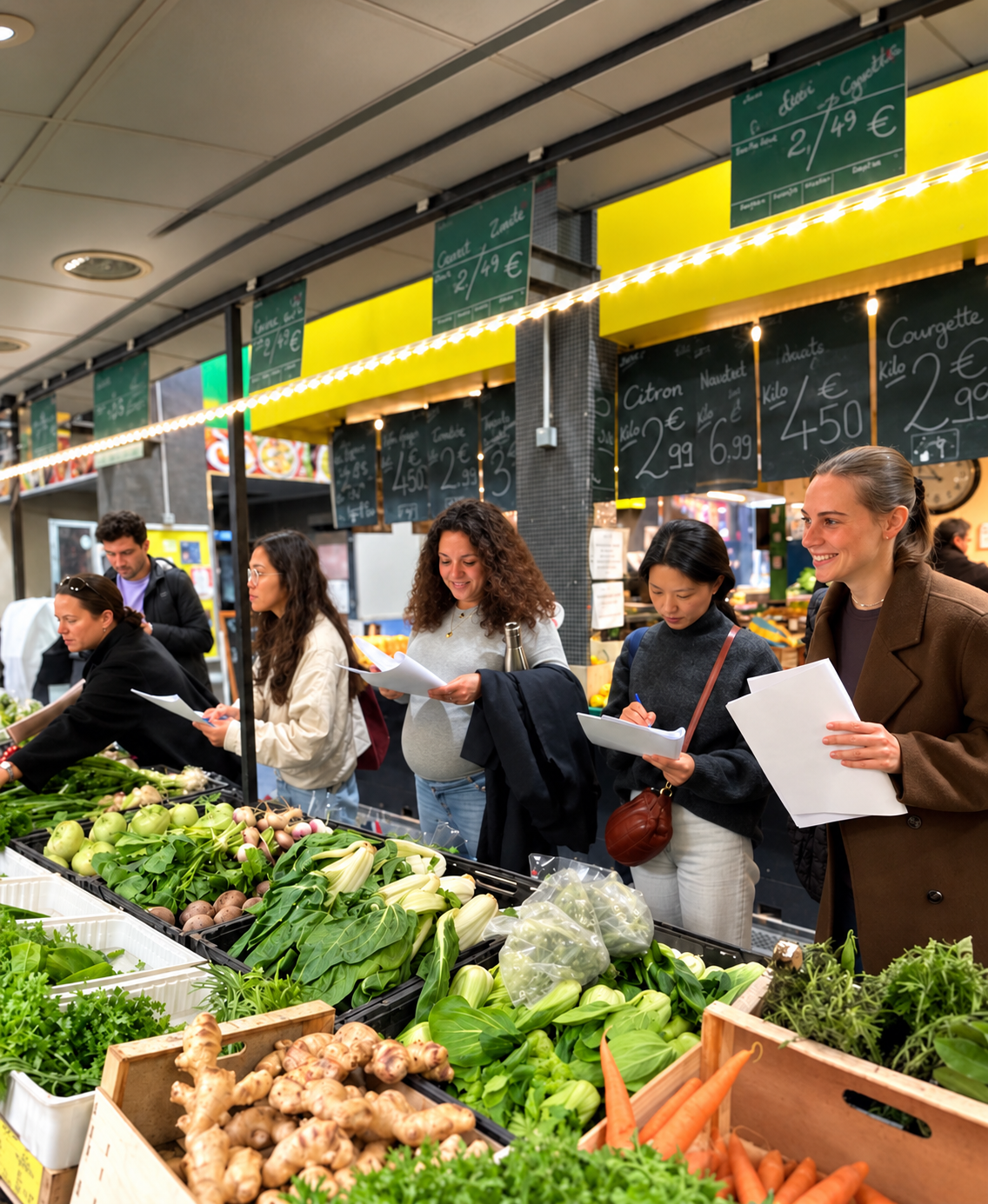
Knowing what to say at a Paris market can make this everyday situation feel much easier.
You’ve been waiting patiently at the fruit stall. It’s finally your turn. You point to the peaches, ready to order, and the seller asks you a question.
You catch the words pour quand, but the rest disappears somewhere between the noise of the market and the customer waiting behind you.
You know the French word for peach. What you don’t know is how to explain that you want to eat them tomorrow, that they shouldn’t be too ripe and that you only need enough for two people.
So you take a chance:
“Pour demain… deux personnes.”
The sentence is far from perfect. It also works.
The seller chooses four peaches, tells you to keep them out of the fridge and places them carefully in a paper bag. You leave with exactly what you needed and one small victory to carry home.
That is the strange thing about speaking French in Paris. Sometimes, the conversations that look the simplest are the ones that require the most courage.
Before we head back to the market, two articles may help you feel more prepared. French Social Codes That Expats Discover Too Late explains why greetings and small rituals matter so much in everyday French life. 10 Micro Challenges to Speak More French Each Week in Paris also offers simple ways to practise French in real situations. Think of your next market visit as one of those challenges.
Start with “bonjour”
The first answer to what to say at a Paris market is simple: bonjour.
At a Paris market, your first word matters more than the name of the product you want to buy.
It sounds obvious. Yet it is surprisingly easy to forget when you are checking prices, thinking about your order and trying to remember whether aubergine is masculine or feminine.
In France, greeting the seller before asking for something is part of the exchange. It creates contact before the transaction begins.
Instead of going straight to:
“Un kilo de pommes.”
Try:
“Bonjour Madame, je voudrais un kilo de pommes, s’il vous plaît.”
There is no need to make the sentence more complicated. A greeting, your request and a merci are already enough.
The same applies when you leave. Even when the stall is crowded, a quick “Merci, bonne journée, au revoir” closes the conversation warmly.
These small words are rarely the vocabulary people worry about learning. At the market, however, they are often the ones that make the biggest difference.
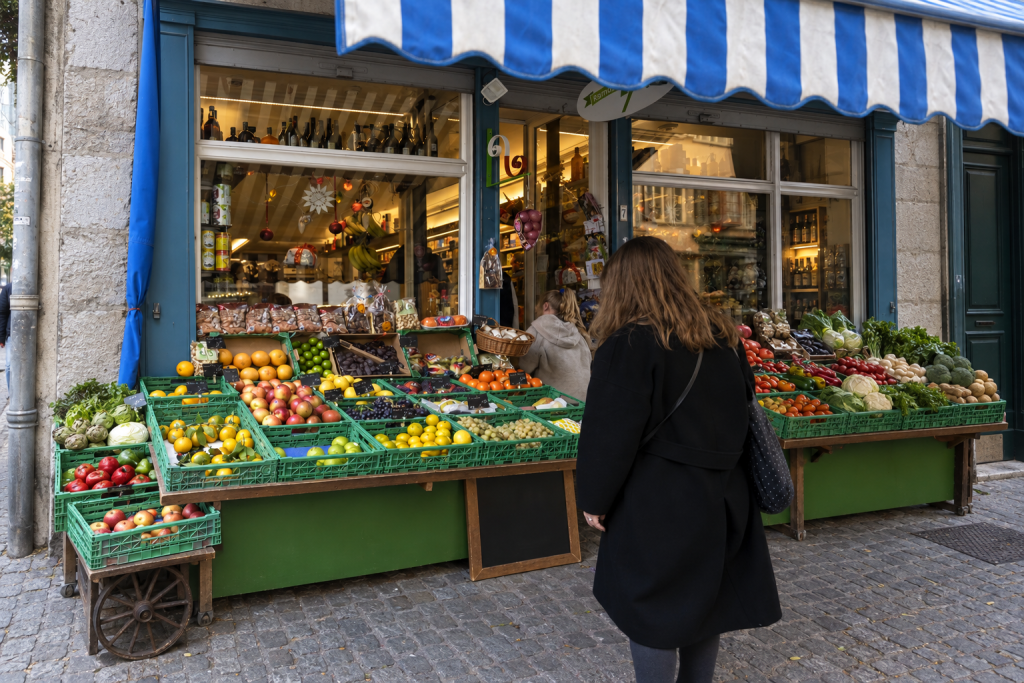
Let the seller help you choose
Some people arrive at the market with a precise shopping list. Others stop because the strawberries look good and decide what to cook later.
If you belong to the second group, use it to your advantage.
When you are unsure what to say at a Paris market, asking for advice is often the easiest way forward.
Market sellers know their products. They can tell you which tomatoes are best for a salad, whether a melon is ready to eat or how much cheese you need for four people. Asking for advice is often easier than trying to find every word by yourself.
At a cheese stall, you might say:
“Je cherche un fromage assez doux. Qu’est-ce que vous me conseillez ?”
At the fishmonger’s:
“Je voudrais préparer du poisson au four. Qu’est-ce qui serait bien ?”
And if you are looking at a vegetable you have never seen before, pointing and asking “Ça se cuisine comment ?” is perfectly acceptable.
The answer may come quickly. Possibly much more quickly than you expected.
Instead of smiling and pretending that everything was clear, ask:
“Pardon, vous pouvez répéter plus lentement, s’il vous plaît ?”
Or repeat the part you think you understood:
“Au four, pendant vingt minutes ?”
You do not need to understand the seller’s entire explanation. You only need the information that will help you when you get home.
What to Say at a Paris Market When the Words Disappear
There will always be a fruit, a fish or a cooking verb that you have never learned. Sometimes, you know the word but cannot find it at the exact moment you need it.
The converstation does not to have to end there.
Point to the product and ask:
“Comment ça s’appelle ?”
If the person before you ordered exactly what you wanted:
“Je voudrais la meme chose, s’il vous plait.”
If you are unsure about the quantity:
“Pour deux personne, il en faut combien?”
And when the word has completely disappeared:
“Attendez, je cherche le mot…”
The last sentence gives you a few seconds to think. It also tells the seller that you are still part of the conversation.
People rarely speak in perfectly constructed sentences, even in their first language. They stop, point, change direction and repeat themselves. A market is not an oral examination. Nobody is waiting to correct your verb ending before selling you an avocado.
Ask one more question
You have greeted the seller, made your request and understood most of the answer. You could pay and leave. Or you could stay in the conversation for another thirty seconds.
Ask where the product comes from:
“Ça vient d’où ?”
Ask if it is in season:
“C’est la saison en ce moment ?”
If the seller has recommended an unfamiliar vegetable:
“Et vous, vous le préparez comment ?”
These questions feel natural because they come directly from what is happening in front of you. You are not searching for an interesting topic or trying to create artificial small talk. You are simply interested in the food and in the seller’s advice.
You may discover a recipe or learn that the pears need another two days before they are ready. Perhaps the exchange will last only a minute. That minute still counts.
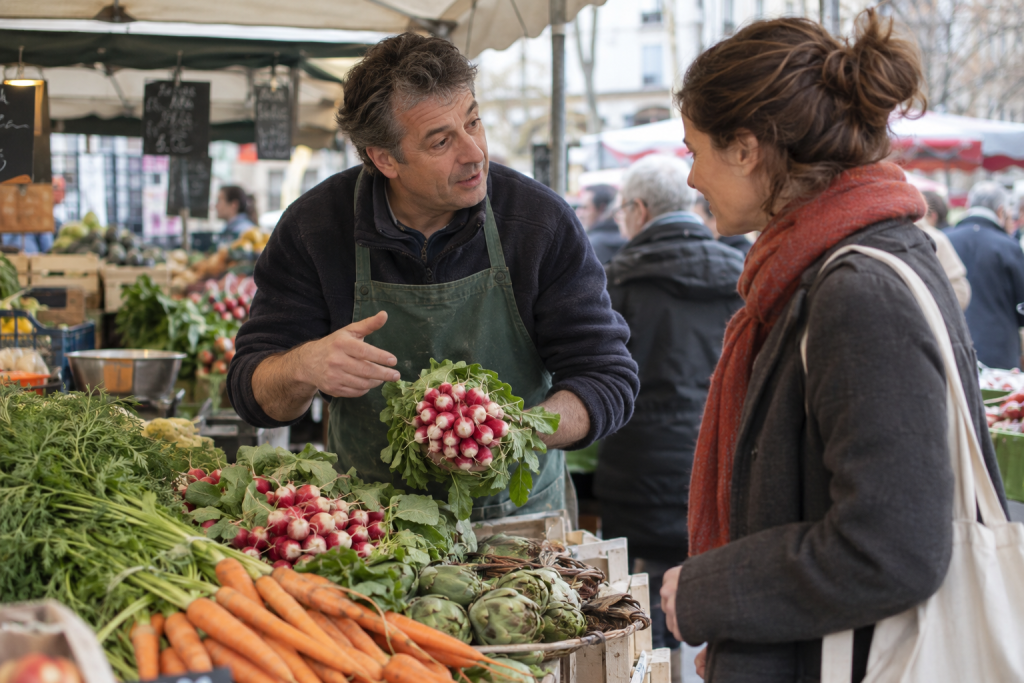
Go back to the same stall
The easiest way to become more comfortable at a Paris market is also the simplest: return.
As you become more comfortable with what to say at a Paris market, each visit begins to feel less intimidating.
The following week, mention what you bought:
“J’ai essayé les tomates que vous m’avez conseillées. Elles étaient délicieuses.”
Now the conversation has a past. The seller may remember you, ask what you prepared or suggest something different for this week.
This is when the market starts to feel less anonymous.
When you first arrive in Paris, you can spend an entire day surrounded by people without seeing a familiar face. Returning to the same places slowly changes that. The baker recognises your order. The café owner knows where you like to sit. A market seller remembers that you prefer mild cheese.
These exchanges are not friendships, at least not yet. They are small signs that you are becoming part of the life around you.
Find your local market, not the perfect one
You do not need to cross Paris to visit the market everyone photographs. Choose one close enough to become part of your weekly routine.
The City of Paris lists 91 markets across the capital, including open-air, covered and specialised markets. Its official directory allows you to search by arrondissement, check the opening days and find a market near your home.
Try visiting when the market is relatively quiet. A seller will naturally have more time to answer a question when ten impatient customers are not waiting behind you.
Once you have chosen your market, begin with one stall. Say bonjour and ask:
“Qu’est-ce que vous me conseillez aujourd’hui ?”
That is enough for a first conversation.
A few words can change your experience of Paris
The following week, return to the same stall. Mention what you bought and whether you enjoyed it. Ask another question if the moment feels right.
Your French may still be hesitant. You may miss part of the answer or realise later that you used the wrong word. The conversation can still be meaningful.
Then, one Saturday morning, you may walk towards the stall and hear:
“Bonjour ! Comme la dernière fois ?”
It is only a short sentence. But when you are building a life in a new city, being remembered can mean more than you expected.
Learning what to say at a Paris market does not mean memorizing an entire conversation. It means having enough words to begin one.
Sometimes, feeling at home in Paris begins with nothing more than a greeting, a question and four peaches in a paper bag.
Absolutely French – Who We Are – Companies Services
Absolutely French is the first French language school entirely dedicated to expat partners and expatriates.
Our mission:
To support dual careers in expat families by helping partners integrate quickly and confidently into French life.
Our method:
Fun, friendly, and innovative French courses that guarantee results — and help build a local network.
 Looking for French classes tailored for expat partners? Want to register your employee’s spouse for a high-quality program?
Let’s connect!
 Email: contact@absolutelyfrench.com
 Phone: +33 (0)1 83 73 98 49
 Address: 4, rue Faraday, 75017 Paris