

When you first move to France, common French abbreviations in texts, emails and official documents can make even a simple Tuesday morning feel like you are decoding a secret message.
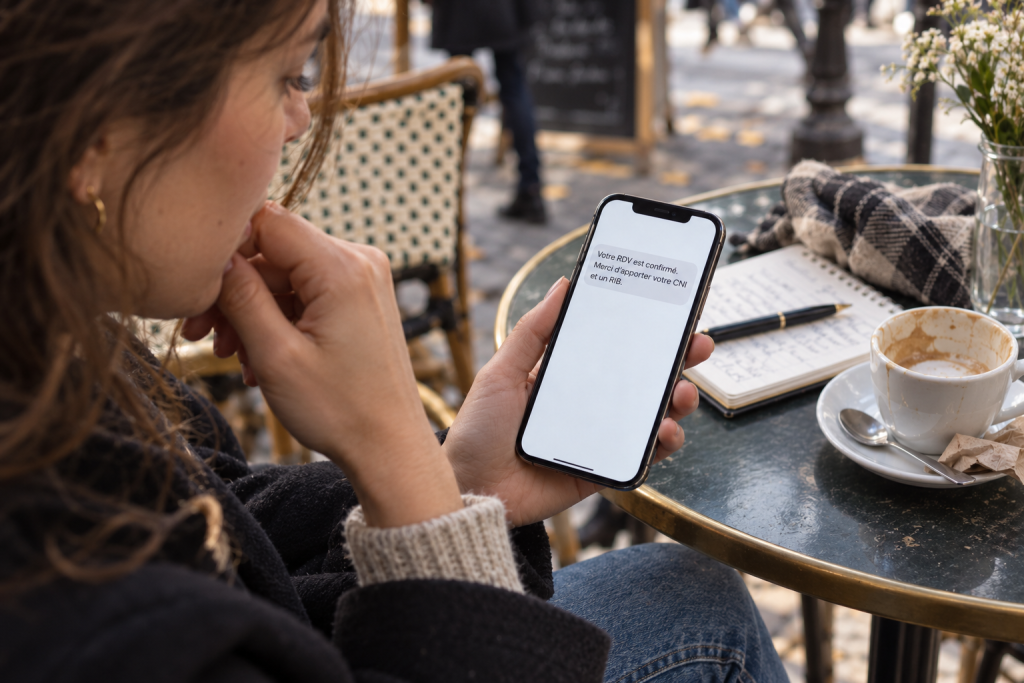
« Votre RDV est confirmé. Merci d’apporter votre CNI et un RIB. »
You read it once. Then twice.
The appointment was confirmed. That part was clear. But if you’re new to France, the rest might feel like someone removed half the words and expected you to understand.
RDV. CNI. RIB.
Three small groups of letters were enough to bring back that uncomfortable feeling: everyone else seemed to understand how life in France worked, while you were still trying to find the instructions.
If you have recently moved to France, perhaps you know this moment. You can order a coffee, greet your neighbour and navigate the métro. Then an administrative email arrives, and suddenly your confidence disappears.
That does not mean your French is bad. You have simply encountered another layer of the language: the shortened, practical French used in appointments, forms, transport, payments and professional life.
Learning French is not only about grammar. It also means understanding the words, habits and small codes hidden in everyday life. Before decoding the abbreviations you will encounter in France, explore these simple ways to practise French in Paris and the French social codes that often surprise expats.
French abbreviations are everywhere. You find them in messages from doctors, notes from school, rental documents, job advertisements and signs in shop windows.
At first, they can make ordinary situations feel more complicated than they are. But every abbreviation you learn removes one small obstacle. A confusing message becomes an appointment you can prepare for. A mysterious document becomes something you can download in a few seconds.
Little by little, uncertainty becomes independence.
The First Mystery: RDV
RDV stands for rendez-vous, meaning appointment.
It is one of those abbreviations that, once understood, seems to appear everywhere: at the doctor, the bank, the hairdresser, your child’s school or a government office.
« Votre RDV est prévu à 14 h. »
Your appointment is scheduled for 2 p.m.
A message that initially felt formal and intimidating suddenly becomes very simple: someone is expecting you at two o’clock.
If you need to arrange or change an appointment, these phrases will help:
« Je voudrais prendre RDV, s’il vous plaît. »
I would like to make an appointment, please.
« Est-ce que je peux déplacer mon RDV ? »
Can I reschedule my appointment?
The first time you use one of these phrases successfully, it may not feel like a major achievement. Yet these are precisely the moments that begin to make daily life feel manageable.
The same message asks you to bring a CNI.
CNI means carte nationale d’identité, the French national identity card.
Now another question appears: what if you do not have one?
This is where many newcomers become nervous. You may wonder whether you have misunderstood the request or whether you will be turned away from the appointment.
Pause before imagining the worst. Depending on the organisation and procedure, your passport or residence permit may be accepted instead.
You can simply ask:
« Je n’ai pas de CNI française. Est-ce que je peux présenter mon passeport ? »
I do not have a French identity card. Can I present my passport?
There is something reassuring about having the exact sentence you need. You are no longer hoping that the problem will solve itself. You can ask, understand and prepare.
For reliable information about identity documents and administrative procedures, consult Service-Public.fr, the official French public-service website.
The final mystery in the message is RIB, or relevé d’identité bancaire. It contains the information required to identify your French bank account.
During your first weeks in France, it may feel as though everyone wants one.
Your employer asks for a RIB. Your landlord may request one. An organisation needs it to send you a refund. Another asks for it to arrange an automatic payment.
The name sounds official enough to suggest a trip to the bank, a paper form and perhaps another appointment. In reality, you can usually download your RIB from your banking app or online account in less than a minute.
That discovery often brings a small wave of relief. The difficult-looking task was not difficult after all. You were only missing one piece of vocabulary.
If somebody requests it, you can ask:
« Est-ce que je peux vous envoyer mon RIB par email ? »
Can I send you my bank details by email?
The next time you see RIB, you will not freeze. You will know exactly where to find it.
CAF and CPAM: Similar letters, very different roles
Once you begin completing administrative procedures in France, two more abbreviations may enter your life: CAF and CPAM.
They are easy to confuse, especially when your inbox is already full of unfamiliar names and requests.
CAF stands for Caisse d’allocations familiales. It manages several forms of family and housing-related support for eligible residents.
You may encounter the CAF when dealing with housing assistance, family benefits or support connected with children.
CPAM means Caisse primaire d’assurance maladie. It is the local health-insurance office you may contact about registration, reimbursements, your carte Vitale or other health-related procedures.
Here is the simplest way to remember the difference:
- A question about family or housing support may concern the CAF.
- A question about public health insurance may concern the CPAM.
For official guidance, visit the CAF and Assurance Maladie websites.
When an unfamiliar abbreviation appears in a message, look first at who sent it. The organisation’s name often provides the clue you need.
CB: a two-letter question at the bakery
Not every French abbreviation belongs to administration.
Imagine that you are standing at the bakery counter. There is a queue behind you, the person serving is waiting, and you hear:
« CB ? »
For one second, your mind goes blank.
Then you remember: CB means carte bancaire, or bank card.
The person is simply asking how you would like to pay.
« Par carte, s’il vous plaît. »
By card, please.
You may also see CB acceptée, meaning card payments are accepted, or CB à partir de 10 €, meaning there is a minimum purchase of €10 for card payments.
It is a tiny interaction, over in seconds. But when you understand and answer without hesitation, something changes. You are no longer translating the entire situation in your head. You are simply living it.
TTC and HTC: The moment the prices change
You find a service at a reasonable price, begin calculating your budget and then notice two versions of the amount: one marked HT and another marked TTC.
HT means hors taxes, or before taxes.
TTC means toutes taxes comprises, or including all taxes.
As a private customer, the TTC price is usually the most important because it generally reflects what you will actually pay. HT prices appear frequently in professional quotations, invoices and business transactions.
Before agreeing to a service, ask:
« Le prix est TTC ? »
Does the price include tax?
It is a short question, but it can prevent the unpleasant moment when the final amount is higher than the one you had in mind.
RER: When the journey goes beyond Paris
Then there is the abbreviation many newcomers learn while standing on a platform and watching the information screen change: RER.
It stands for Réseau express régional.
The RER connects Paris with destinations across the wider Île-de-France region. Some lines pass through central Paris, but they may travel much farther than the métro and do not always stop at every station.
Before getting on, check the line, direction, final destination and stops.
You might hear:
« Le prochain RER B est direct jusqu’à… »
Perhaps you will still take the wrong train once. Most people do at some point. But the system becomes less intimidating each time you understand one more part of it.
For official routes and live travel information, consult the RATP website.
CDI and CDD: A few letter with a major meaning
French abbreviations also follow you into professional life.
When reading job advertisements, you will quickly encounter CDI and CDD.
CDI means contrat à durée indéterminée: an employment contract without a predetermined end date.
« Poste en CDI » means a permanent position.
CDD means contrat à durée déterminée: a fixed-term employment contract.
« CDD de six mois » means a six-month contract.
For someone rebuilding a career after an international move, these letters carry more than a definition. They help you understand what kind of future an opportunity may offer before you even open the complete job description.

Can you decode the message now?
A few months after arriving in France, you receive:
« Votre RDV avec les RH est confirmé. Merci d’apporter votre CNI, votre RIB et votre contrat en CDD. »
This time, you do not feel lost.
Your appointment with RH, or ressources humaines, is confirmed. You need to bring your identity document, bank details and fixed-term employment contract.
The message has not become simpler. You have become more familiar with the language surrounding your life.
That difference matters.
Small letters, real independence
Learning French is not only measured by how long you can speak or how perfectly you use a verb tense.
Sometimes, progress is quieter.
It is recognising RDV in a text message without feeling anxious. It is knowing that your RIB is waiting in your banking app. It is seeing TTC on a quotation and understanding the final price. It is hearing « CB ? » at the bakery and answering naturally.
Nobody else may notice these little victories, but you will feel them.
Each abbreviation you understand removes a moment of hesitation. Each successful interaction makes you a little more confident. France gradually feels less like a complicated system you are observing from the outside and more like a place in which you know how to move.
One day, another message will arrive filled with shortened words. You will read it, understand it and continue with your day.
Only afterwards might you realise how far you have come.
Your small challenge for this week
For the next seven days, make a note whenever you encounter an unfamiliar French abbreviation.
Before searching for its meaning, look at the context:
- Who sent the message?
- Is it about money, transport, work, health or an appointment?
- What action are you being asked to take?
- Can the surrounding words help you decode it?
The goal is not to memorise an entire dictionary. Start with the small codes that already appear in your own life.
Which French abbreviation confused you most when you first arrived?
Absolutely French – Who We Are – Companies Services
Absolutely French is the first French language school entirely dedicated to expat partners and expatriates.
Our mission:
To support dual careers in expat families by helping partners integrate quickly and confidently into French life.
Our method:
Fun, friendly, and innovative French courses that guarantee results — and help build a local network.
 Looking for French classes tailored for expat partners? Want to register your employee’s spouse for a high-quality program?
Let’s connect!
 Email: contact@absolutelyfrench.com
 Phone: +33 (0)1 83 73 98 49
 Address: 4, rue Faraday, 75017 Paris