

She was twelve minutes late for dinner when a stranger in slippers opened the door and looked down at her apple tart.
« C’est pour moi ? »
Is that for me?
Behind him, a small dog was doing everything in its power to make the answer yes.
Priya looked at the number on the landing. Second floor. She looked at Camille’s message. Also second floor.
Somewhere, she had made a very confident mistake.
Twenty minutes earlier, she’d been walking down the street thinking about how nice it was to have plans of her own. Since moving to Paris for her partner’s job, most of her evenings out had been with people he already knew. Camille was someone she’d met herself, in French class. This was the first time Camille had invited her over.
Priya had picked up dessert, put on the shoes she’d been saving for an occasion and practised how to say, « Merci de m’avoir invitée. » Thanks for inviting me.
She hadn’t practised how to say, “I’ve brought your neighbour’s dessert to your dog.”
Here’s what went wrong, and what to ask before your first visit to a Paris apartment building.
1. Get the full door code before you arrive
Camille’s text had looked complete.
« Numéro 24. Deuxième étage. À ce soir ! »
Number 24. Second floor. See you tonight.
At number 24, Priya found a tall blue door, a brass handle and a keypad. She pulled the handle. Then she pushed it. Then she pulled it again, with the determination of someone who had run out of ideas.
Camille sent the code. Priya typed the four digits. Nothing happened. She read the message again and noticed the B at the end.
The door clicked.
A digicode is the keypad you may find at the entrance to a Paris apartment building. Copy the entire code, including any letters, and check the instructions your host sends. If the keypad accepts the code and you hear a click, try the door while it’s unlocked.
« Tu peux m’envoyer le code de la porte ? »
Can you send me the door code?
Priya gave the door a push. Behind it was a cobbled courtyard with three entrances and no obvious reason to pick one over the others.
2. Ask which entrance to take across the courtyard
There was a glass door to the left, another at the far end and a third beside the bins. Through the glass door she could see a staircase. More importantly, she could see someone going up it with a bottle of wine.
Excellent, Priya thought. A fellow dinner guest.
She followed him.
A single Paris apartment building address can lead to several entrances or staircases. Some older properties have a courtyard tucked behind a large gateway called a porte cochère. The City of Paris documents an eighteenth-century example on rue Cadet, where the courtyard is hidden behind the entrance. Read about the rue Cadet building.
If your host mentions bâtiment B, look for building B. If they say escalier B, look for staircase B. And if they say au fond de la cour, go to the far end of the courtyard.
« Je suis dans la cour. Je prends quelle porte ? »
I’m in the courtyard. Which door should I take?
Had Priya sent that message, she would have learned that Camille’s entrance was at the far end. Instead, she watched her fellow guest unlock his own flat on the first floor and disappear inside with his wine.
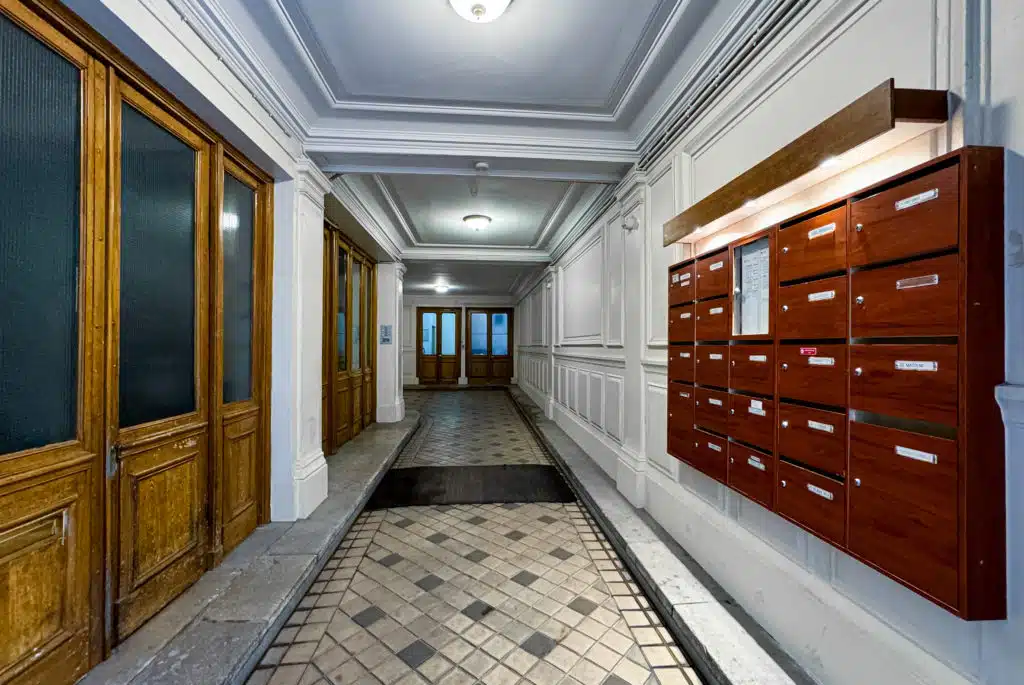
3. Check the staircase as well as the floor
Priya carried on upstairs. One flight, then another. The landing had two doors. From behind the one on the right came a burst of laughter.
She rang.
That was how she met the man in slippers and his dog.
« Je cherche Camille », she said. I’m looking for Camille.
« Vous êtes dans quel escalier ? » he asked.
Which staircase are you in?
Priya looked behind her. Until that moment, she’d thought she was in the staircase.
In a Paris apartment building with several staircases, deuxième étage only tells you how far up to go. You still need to know which entrance to use. On a keypad or in a lift, RDC usually stands for rez-de-chaussée, or ground floor. The premier étage is one floor above ground level. The deuxième étage is two floors up.
« C’est quel escalier ? »
Which staircase is it?
Priya called Camille. There was a short silence.
“Are you with a man in slippers?”
Priya looked down. “Yes.”
“Tell him I still have his salad bowl.”
4. Ask which name to ring on the intercom
Back in the courtyard, Priya found the right door. Beside it was an intercom with a list of surnames.
She knew Camille’s coffee order, the name of her dog and exactly how she felt about their last French homework. She had no idea what her surname was.
« Je sonne à quel nom ? »
Which name should I ring?
« Martin. Je t’ouvre ! »
Martin. I’ll buzz you in!
An interphone at a Paris apartment building may list a surname or give you a directory to scroll through. Ask for the name as it appears on the panel. It could be a flatmate’s or a partner’s. If the street door and the courtyard door both require access, ask about each one.
« Il y a un deuxième code après la cour ? »
Is there a second code after the courtyard?
The intercom buzzed. Priya waited for the door to open by itself. The buzzing stopped.
She rang again.
“Were you waiting for it to open on its own?” Camille asked.
“A little bit.”
This time, Priya tried the handle as soon as she heard the buzz. The door opened.
5. Ask about the lift if you’re carrying something bulky
Inside, Priya found a tiny lift. She stepped in sideways to keep the tart level. The doors started to close, caught the edge of the cardboard box and opened again.
By now, Priya was more worried about the tart meeting Camille than she was about meeting anyone at dinner.
If you’re visiting a Paris apartment building with a suitcase, a stroller or something awkward to carry, ask whether there’s a lift and whether you’ll need to climb any steps to reach it. If space matters, ask about that too.
« Il y a un ascenseur ? Une poussette rentre dedans ? »
Is there a lift? Will a stroller fit inside?
Priya tucked one flap of the box under her arm and made it to the second floor. The tart had lost a slice of apple to the lid. It was still presentable if she opened the box facing the right way.

6. Get one last detail for the landing
Two doors. Again.
Priya stood still. From the left came music. From the right came the sound of someone pulling a chair across the floor. She had a fifty-fifty chance and a recent history of poor decisions.
One last message.
« Je suis au deuxième. C’est la porte de gauche ou de droite ? »
I’m on the second floor. Is it the door on the left or the right?
In a Paris apartment building with more than one flat on a landing, porte de gauche means “door on the left” and porte de droite means “door on the right”. Asking for that last detail is especially handy if there are no flat numbers on the doors.
The door on the right opened. Camille was holding two glasses.
“Did you bring a tart?”
“I did,” Priya said. “It’s already met some of the neighbours.”
7. Send your own guests directions they can follow
A few weeks later, Priya invited Camille over. She started typing her address and floor, then stopped. She pictured someone standing outside her own Paris apartment building with their phone in one hand and dessert in the other.
She sent this.
« Le digicode est à droite de la grande porte. Traverse la cour et prends la porte vitrée à gauche. Sonne chez Shah. Troisième étage, porte de droite. »
The keypad is to the right of the main door. Cross the courtyard and take the glass door on the left. Ring Shah. Third floor, door on the right.
If you’re giving someone directions, write them in the order your guest will need them. Start with the street entrance. Then give the courtyard route or staircase, the intercom name, the floor and the door. For your next visit to a Paris apartment building, you can ask for those details in one message.
« Tu peux m’envoyer le code, le nom sur l’interphone, l’étage et la porte ? Il y a plusieurs entrées ? »
Can you send me the code, the name on the intercom, the floor and which door it is? Are there several entrances?
Camille arrived on time. She brought an apple tart.
“Straight here?” Priya asked.
“Straight here.”
Priya took the box. “Shame. I know a dog who would’ve loved to meet you.”
Absolutely French – Who We Are – Companies Services
Absolutely French is the first French language school entirely dedicated to expat partners and expatriates.
Our mission:
To support dual careers in expat families by helping partners integrate quickly and confidently into French life.
Our method:
Fun, friendly, and innovative French courses that guarantee results — and help build a local network.
 Looking for French classes tailored for expat partners?
 Email:
 Phone:
 Address: 4, rue Faraday, 75017 Paris